Business Management is that branch of education that provides knowledge and training pertaining to planning, execution, supervision, and analysis of a business enterprise. In this field of education, one learns about the establishment of a company or an organisation, and various functional levels such as production, financial, administrative, human resources, sales & marketing, and others.

Business Management is open to students from all streams – Commerce, Science and Arts – and can be pursued at undergraduate (BBA/BMS), postgraduate (MBA/PGDM) and doctoral (PhD, FPM) levels. These courses will help students in building managerial abilities such as communication, organisation, leadership, reporting, and teamwork. It will also help prospective entrepreneurs to advance their careers and act as a platform for someone who wishes to start their own business soon after graduating from college.

Career-scope after completing a business management degree course is huge with a variety of managerial jobs on offer at junior as well as senior levels. After completing an undergraduate course, a candidate is hired as an executive across functional areas and after completing a post-graduate course in business management, a candidate is hired at the managerial level.
Business Management Eligibility Criteria
Business Management is divided broadly into two levels: Undergraduate and Postgraduate.
Check below business management eligibility criteria for BBA and MBA:


Business Management Top Entrance Exams
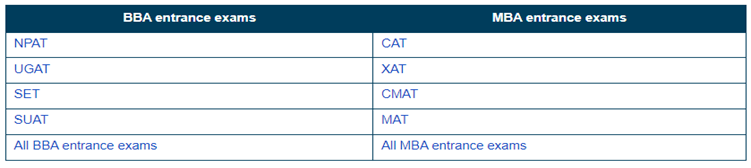
Most of the business management institutes select candidates for admission on the basis of entrance exam scores. Some b-schools accept scores of national level exams, while some conduct their own entrance exam. We have listed top BBA and MBA entrance exams below:

Specialisations in BBA & MBA
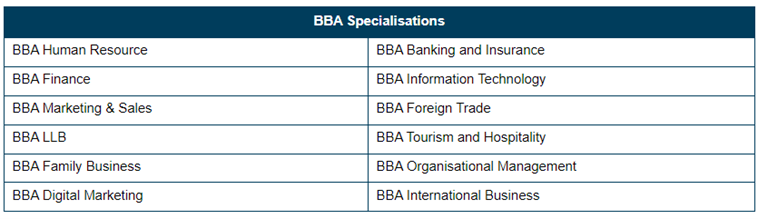
Check the tables below for lists of specializations offered by institutes, colleges, and universities:
BBA Specialisations
MBA Specialisations

Business Management Subjects and Syllabus
In both BBA and MBA, some subjects are core topics taught at the initial stages of these courses. In the advanced stages, elective courses and specializations are taught. Given below is the list of core subjects and topics taught in BBA and MBA.

BBA Syllabus


MBA Syllabus

Business Management Job Profiles
Management Trainee
A management trainee’s job is to perform managerial duties under the guidance of seniors, learn various business operations and ensure that the tasks assigned are completed within the deadline.
Sales Representative
A Sales Representative’s job profile includes the sale of goods and services, customer relations, maintaining a record of current customers, and bringing new customers.
Marketing Executive
The job of a marketing executive is to devise plans to increase the reach of goods and services thereby increasing sales. Their job role includes performing tasks set by seniors, maintaining records, and helping in strategizing and executing marketing campaigns.

Manager
A manager’s job is to lead and oversee a team’s performance to increase company revenue. A business organization hires Managers for each department to plan, execute and maintain day to day functioning of a department, encourage the team in optimizing their performance, and meet the targets within the deadline.
Assistant Manager
The job of an assistant manager is to assist the manager in the smooth functioning of the department, perform some managerial tasks and oversee the team members on the manager’s behalf.
Financial Analyst
The job of a financial analyst is to explore and assess investment opportunities on behalf of an individual or a business enterprise. They advise investment in bonds, securities, mutual funds, banks, stocks, etc.
Business Analyst
The job of a business analyst includes analyzing the current status of a business, forecasting, outlining problems, finding out solutions, and budget planning for new projects. A business analyst acts as a business advisor of the stakeholder in helping him plan future projects.

FAQs on Business Management & Studies
Q. I am from Arts stream. Can I pursue a Business Management degree course?
Ans: Yes, candidates from all streams - Arts, Science, and Commerce - can pursue Business Management degree courses at undergraduate and postgraduate levels. This course is open for students of any stream as any person can learn managerial skills.

Q. Does Business Management require Maths?
Ans: No, Business Management courses don’t require Maths but in specialisations such as Finance, Taxation, Data Analytics, Data Science and Information Technology, knowledge of Maths at an advance level is necessary.
Q. Which are the good Business Management degrees at undergraduate level?
Ans: BBA, BMS, BBM, BBA LLB, Integrated MBA courses such as BBA+MBA and BTech+MBA are some of the good Business Management degrees at undergraduate level.
Q. Which are the good Business Management degrees at postgraduate level?
Ans: MBA, MMS, PGDM and PGP are some of the good Business Management degrees at postgraduate level.
Q. Are Business Management courses offered in government colleges too?
Ans: Yes. Although Business Management is considered a professional course, MBA and BBA are offered by many central, state and open universities across India. The government institutions offering Business Management courses also provide campus placement.

Q. What is the minimum eligibility criteria for BBA/BMS?
Ans: The minimum eligibility criteria for BBA/BMS is minimum 50 per cent aggregate or equivalent CGPA in Class 12/HSC. For reserved category candidates, the minimum aggregate required is 45 per cent.
Q. What is the minimum eligibility criteria for MBA/PGDM?
Ans: The minimum eligibility criteria for MBA/PGDM is minimum 50 per cent aggregate or equivalent CGPA in bachelor’s degree programme. For reserved category candidates, the minimum aggregate required is 45 per cent.
Q. What are the top MBA entrance exams in India?
Ans: CAT conducted by the IIM is the top MBA entrance exam in India. Apart from CAT, the top MBA entrance exams in India include XAT, CMAT, NMAT, MAT, IIFT, SNAP and GMAT.

Q. What are the top BBA entrance exams in India?
Ans: The top BBA entrance exams in India include Symbiosis-SET, NPAT, UGAT, CUET and DUJAT.
Q. Is it beneficial to pursue MBA after completing BCA or BTech?
Ans: MBA with BCA or BTech is a popular combination among young students who plan to make a career in Operations and Information Technology domains. Jobs after BCA+MBA or BTech+MBA are quite rewarding with managerial or consultant level positions and high pay packages.

Q. Which is the best B-school in India?
Ans: IIMs are considered the best B-schools in India. According to MHRD-NIRF ranking, IIM Ahmedabad is ranked as the top B-school in India, followed by IIM Bangalore, IIM Calcutta and IIM Kozhikode.
Q. Does the Indian Institute of Management offer BBA courses as well?
Ans: IIM Indore, IIM Rohtak, IIM Ranchi, IIM Jammu and IIM Bodh Gaya offer five-year Integrated Management Programme (IPM) which is a BBA+MBA course.